Apuan Alps Heritage Collection
BIANCO CARRARA GIOIA
Bianco Carrara Gioia is the marble of choice for those seeking profound visual impact.
Unlike the subtle clouds of standard Carrara, the Gioia variety is defined by a brilliant
white calcitic background aggressively intersected by thick, dynamic, and highly pronounced grey veins.
01. ORIGIN
The Gioia Quarries
This specific lithotype historically originates from the "Cave di Gioia" (Gioia Quarries)
located in the Colonnata basin of the Apuan Alps. The intense geological pressure in this
specific fault line created the dense, spider-web-like veining that makes this stone so highly sought after.
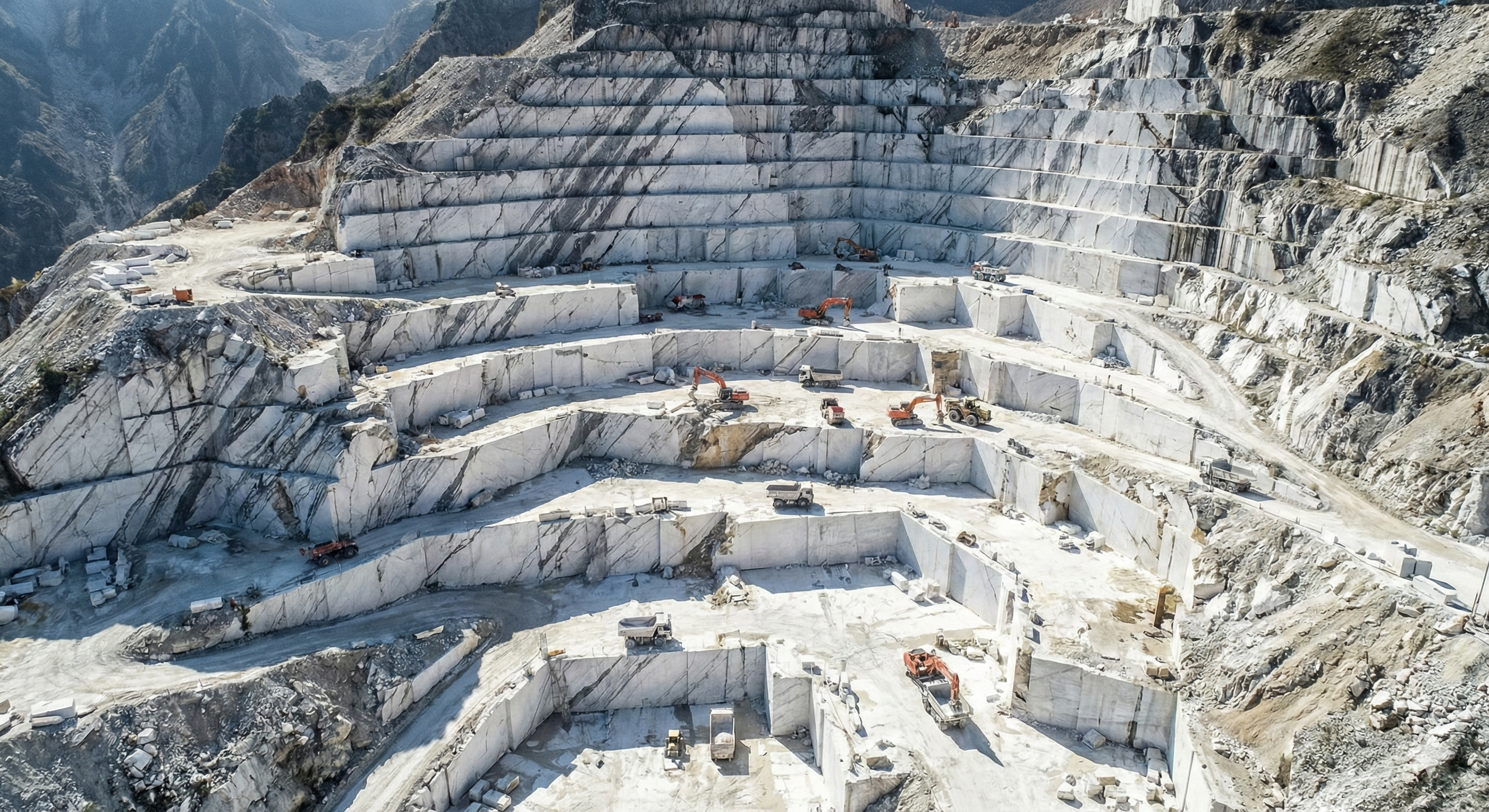
ORIGIN - The Heart of Colonnata
02. MATERIAL
Dynamic Veining
The material is characterized by intense contrast. The veins in Carrara Gioia are darker and
more abundant than in the 'C' grade, often forming intricate, interconnected networks.
This structural density makes it exceptionally robust and ideal for large-scale bookmatching.
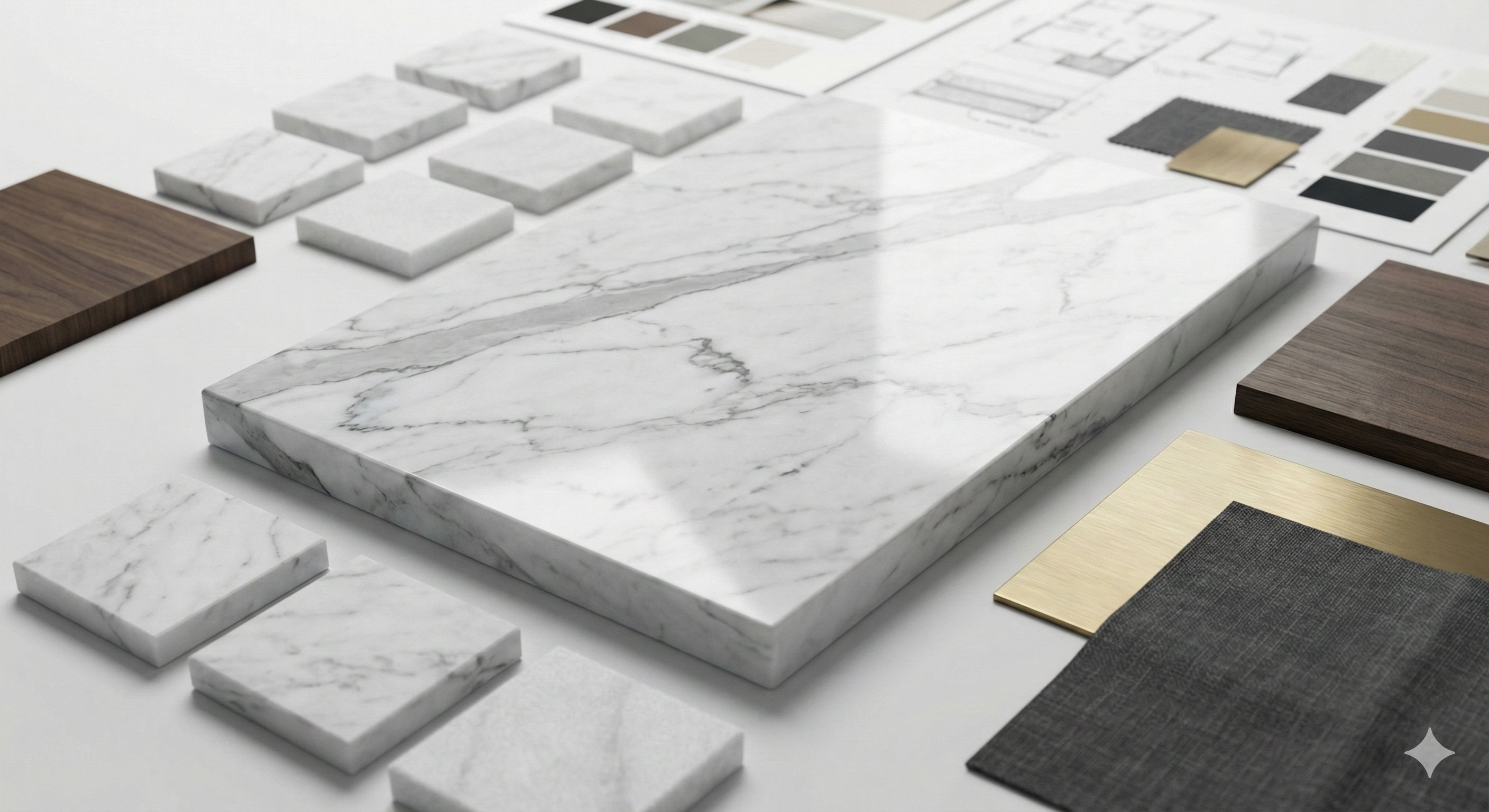
MATERIAL - High-Contrast Slabs
03. DESIGN
Architectural Character
Interior designers favor Bianco Carrara Gioia when a space requires "movement" and character.
It is exceptional for vast flooring applications, where its busy pattern successfully hides wear,
and for statement bathroom walls that demand a focal point without stepping into the Calacatta price tier.
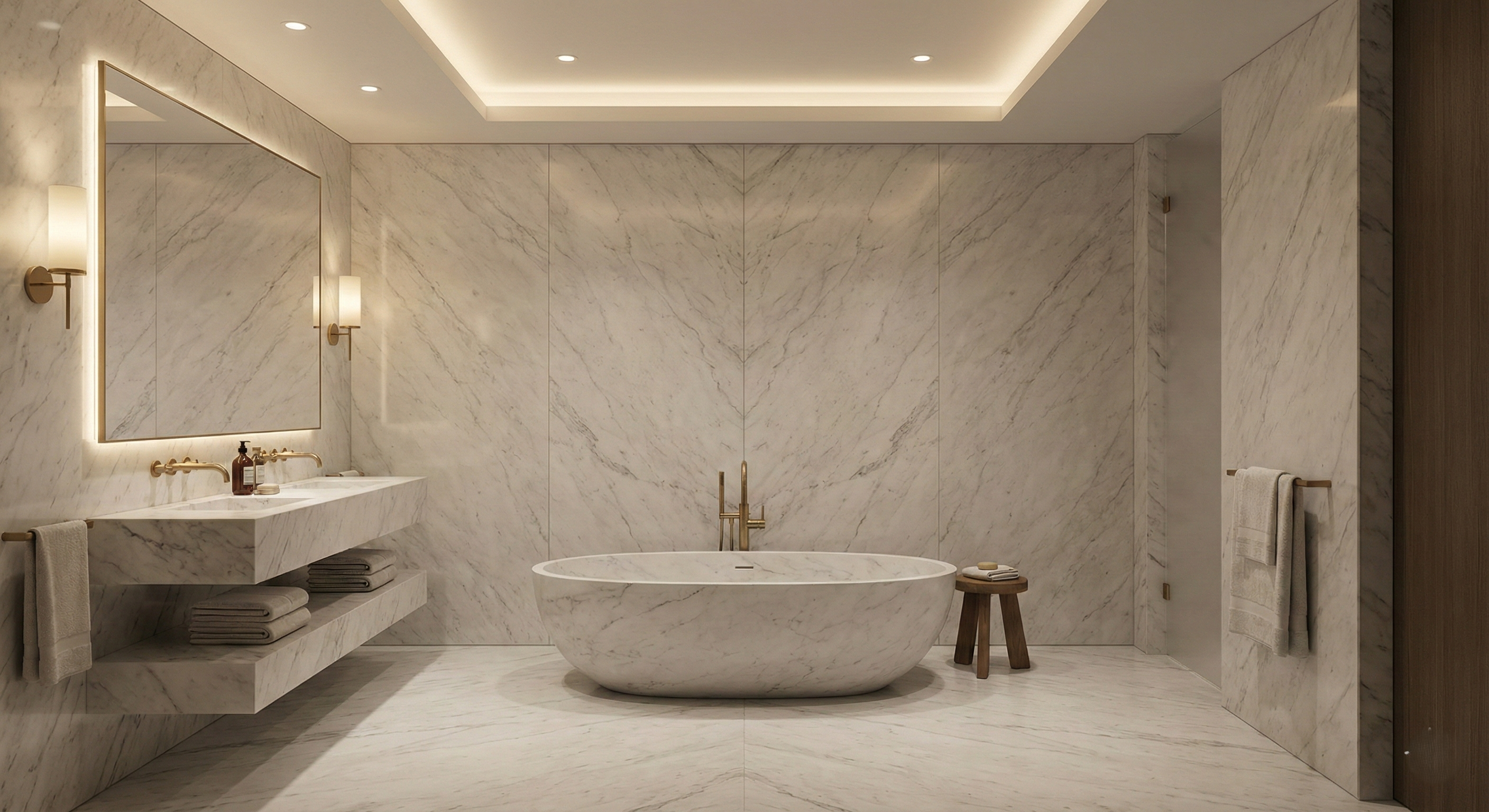
DESIGN - Dynamic Interiors
04. ART
Solid Masterpieces
Due to its high structural compactness, Carrara Gioia is an excellent medium for complex CNC milling
and heavy sculptural work. We utilize it to create monumental staircases, monolithic dining tables,
and heavily textured architectural columns.
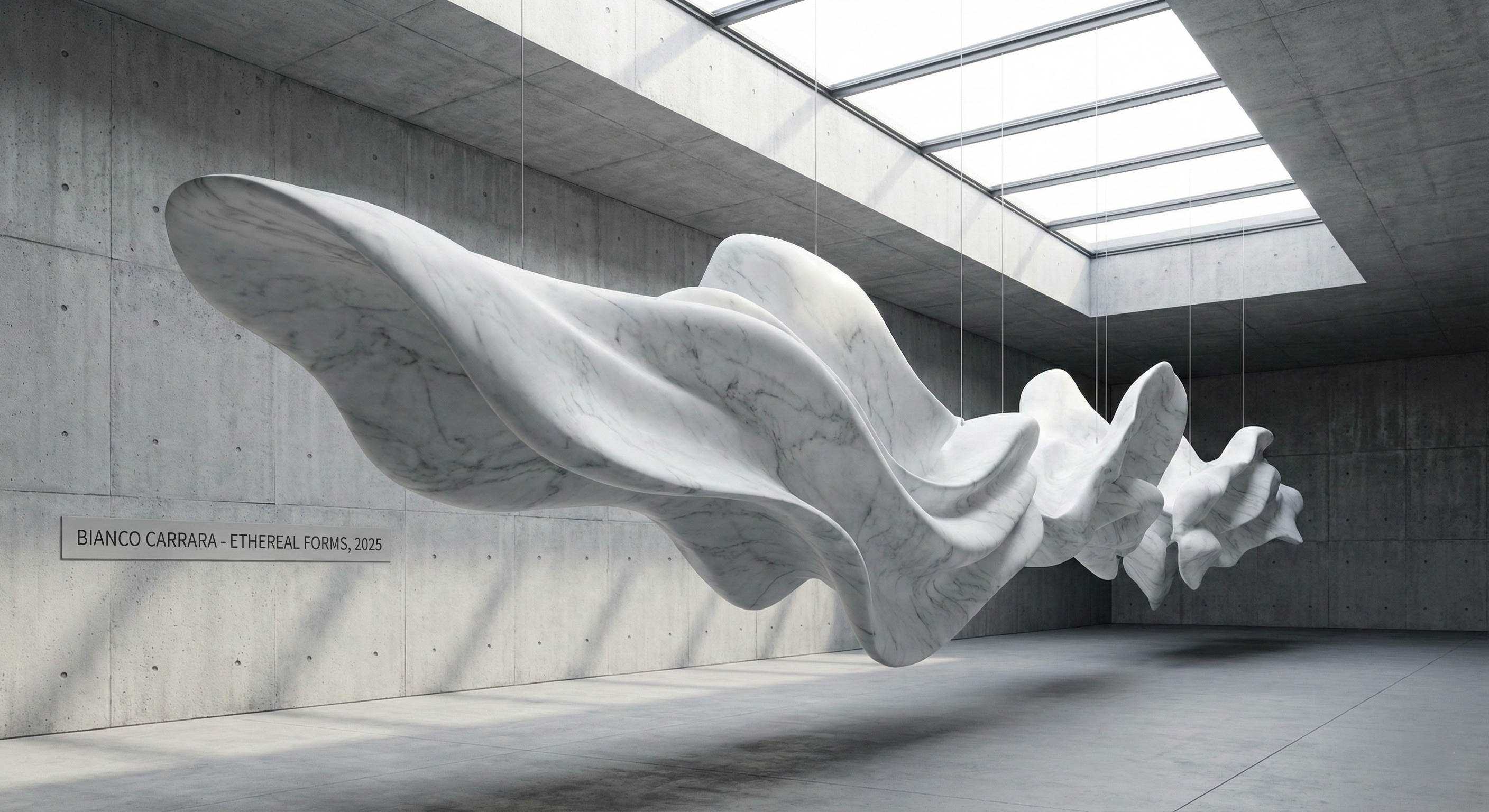
ART - Structural Sculpting
Bianco Carrara Gioia - Technical & Professional FAQ
01. What defines Bianco Carrara Gioia?
It is a specific grade of Carrara marble characterized by a white base and very dense, pronounced, and dynamic grey veining.
02. How does Gioia differ from Carrara C?
Carrara C has soft, feathery veins. Gioia has much darker, thicker, and busier vein patterns that create a higher contrast.
03. Gioia vs Statuario?
Statuario has a pure ice-white base with isolated, dramatic veins. Gioia has a more uniform distribution of intersecting grey veins across the entire slab.
04. Why the name 'Gioia'?
It is named after the 'Cave di Gioia' (Gioia Quarries) in the Colonnata basin of Carrara, where this specific pattern is abundantly found.
05. Does it have golden veining?
No, authentic Bianco Carrara Gioia strictly features grey to dark-grey veins without golden or brown intrusions.
06. Is it an affordable luxury option?
Yes. It offers an incredible visual impact similar to rare marbles but at a much more accessible price point for large projects.
07. What is 'Venatino' compared to Gioia?
Venatino features distinct parallel stripes, whereas Gioia's veins intersect in a more chaotic, web-like pattern.
08. Can it be used for commercial projects?
Absolutely. Its busy pattern is highly practical for commercial spaces because it effectively hides dust and light foot-traffic marks.
09. Is it considered a classic marble?
Yes, it has been heavily utilized in classical Italian architecture for centuries when a highly decorated look was desired.
10. Are blocks readily available?
Yes, the Gioia basin is highly productive, allowing us to supply large quantities of consistent material for mega-projects.
11. What is its Mohs hardness?
It ranks between 3 and 4 on the Mohs scale, typical for dense Carrara calcitic marbles.
12. Is it denser than regular Carrara?
Often, yes. The high concentration of mineral veins can make it slightly more compact and structurally robust.
13. Is it porous?
Yes, like all natural marble, it contains micro-pores and must be professionally sealed to prevent staining from liquids.
14. What are standard slab thicknesses?
Standard slabs are produced in 20mm and 30mm. Custom monolithic blocks are cut to order.
15. Best finish for high traffic floors?
A Honed (matte) finish is ideal as it hides micro-scratches, while the busy Gioia pattern disguises daily wear.
16. Can it withstand freezing?
If properly installed and sealed, it has good frost resistance, though exterior use should be evaluated based on the specific climate.
17. Is it suitable for underfloor heating?
Yes, marble has excellent thermal conductivity and mass, making it perfect for radiant floor heating.
18. Does the grey veining fade?
No, the mineral composition of the veins is UV-stable and will not fade in direct sunlight.
19. Can it be bookmatched?
Yes! The dense veins of Gioia create incredibly intricate and dramatic kaleidoscopic patterns when bookmatched.
20. What is the weight per square meter?
A standard 20mm slab weighs approximately 55-58 kg per square meter.
21. Is it good for kitchen countertops?
Yes, it is highly popular. However, it is a calcitic stone and will etch if exposed to acids (lemon, wine).
22. What does etching look like on Gioia?
Etching creates dull spots. Because Gioia has a very busy pattern, etching is much harder to notice than on pure white marbles.
23. Ideal for luxury bathrooms?
It is a spectacular choice for full floor-to-ceiling cladding, creating a highly immersive, textured environment.
24. Slip resistance for showers?
For wet areas, a honed, brushed, or sandblasted finish must be applied to meet standard slip-resistance ratings.
25. Best metals to pair with Gioia?
Matte black and gunmetal grey fixtures highlight its dramatic dark veins, while polished chrome offers a crisp, clean contrast.
26. Wood pairings?
It pairs beautifully with dark woods like Walnut or Wenge, creating a very masculine and sophisticated aesthetic.
27. Can it be used for exterior facades?
Yes, it is frequently used on commercial facades. We recommend 30mm thickness on a mechanical ventilated facade system.
28. Is it translucent?
Due to the high density of dark veining, it is generally not recommended for backlighting applications.
29. Can you fabricate custom bathtubs?
Yes, the structural integrity of Gioia makes it an excellent candidate for heavy 5-axis CNC carving.
30. What grout color is recommended?
Use a premium, non-sanded grout in a light grey shade to blend seamlessly with the busy veining.
31. How to clean it daily?
Use a damp microfiber cloth with a dedicated pH-neutral stone cleaner. Avoid acidic or abrasive supermarket cleaners.
32. How often should it be sealed?
In high-moisture areas like kitchens and bathrooms, apply an impregnating sealer every 12 months.
33. Can it be re-polished?
Yes, if the floor loses its shine over decades, a professional can re-polish it in-situ to look brand new.
34. What adhesive must be used?
Use high-performance, rapid-setting WHITE thin-set. Grey adhesives can cause moisture shadows to bleed through the white base.
35. Do you offer 'cut-to-size' services?
Yes, we convert architectural DWG files into fully finished, ready-to-install panels for international projects.
36. What is the 'Dry-Lay' process?
We arrange the cut tiles on our factory floor to ensure perfect color distribution and vein matching before shipping.
37. How is it packed for export?
Material is packed in fumigated ISPM-15 wooden crates, reinforced and foam-lined to withstand ocean freight.
38. Is the extraction ethical?
Yes, extraction in the Apuan Alps strictly adheres to Italian labor laws and stringent environmental sustainability protocols.
39. Can I inspect the blocks remotely?
We provide high-resolution photography and live video walkthroughs for our clients to approve blocks before slicing.
40. How do I get a quote?
Send your Bill of Quantities (BOQ) or architectural plans to info@marmidicarrara.com for a detailed estimate.